 By usasmooths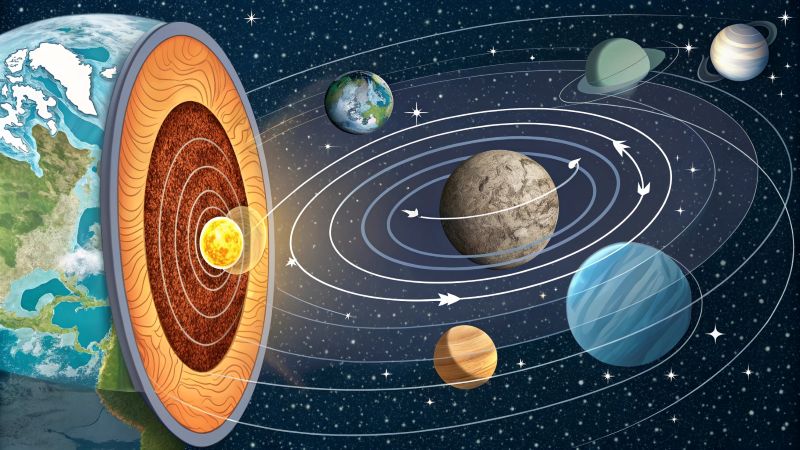
Finding accurate edgenuity earth and space science answers can be challenging, especially when lessons feel overwhelming or time-consuming. Many students struggle with complex concepts like plate tectonics, astronomy, weather systems, and Earth’s geological processes.
This guide provides a clear, structured, and student-friendly overview of the course—without cheating—so you learn the material andboost your grades with confidence.
This will help you understand the structure of Edgenuity Earth and Space Science, master key topics, and learn how to approach quizzes, warm-ups, unit tests, and cumulative exams more effectively.
Edgenuity Earth and Space Science is a full-year online high school science course focused on Earth’s systems, natural processes, and the universe. The course blends interactive modules, video instruction, assessments, and lab simulations.
Many students search for edgenuity earth and space science answers because the coursework is dense, and assignments can take longer than expected.
The curriculum covers scientific inquiry, Earth’s structure, geological processes, water systems, climate, space, and astronomy. Teachers rely on Edgenuity to measure comprehension, so it’s important to understand—not memorize—concepts for long-term success.
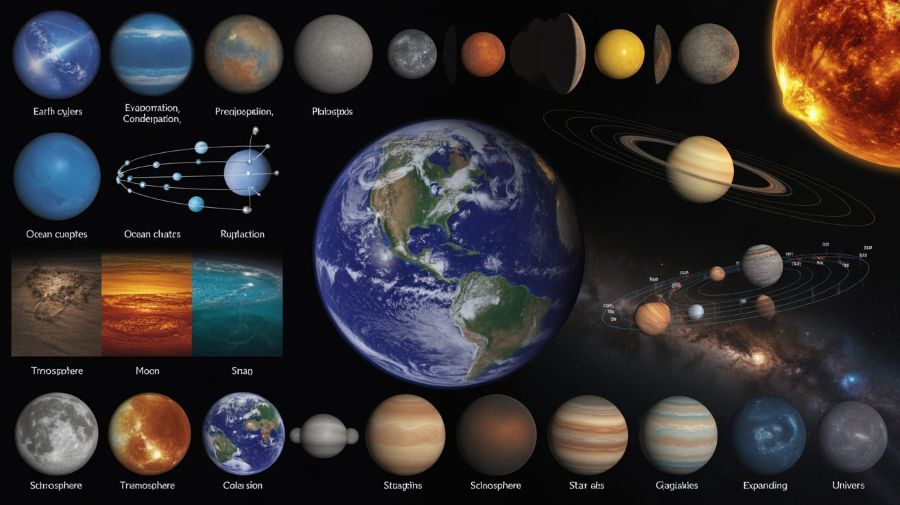
Each unit contains:
- Warm-Up Questions
- Instruction Videos
- Summary Notes
- Assignments
- Quizzes & Tests
Because quizzes pull randomized questions, memorizing direct edgenuity earth and space science answers rarely works across attempts. Instead, understanding the logic behind the questions helps you score consistently.
This unit introduces the scientific method, experimentation, measurement, and lab safety. You’ll understand variables, hypotheses, and data analysis.
- Understanding Independent and Dependent Variables
- Evidence-based conclusions
- Measurement accuracy
- Controlled experiments
Students often search for edgenuity earth and space science answers for Unit 1 because of detailed data tables and graph interpretations. Focus on recognizing trends, comparing results, and interpreting changes in variables.
Explore the Structure of the Earth:
- Crust
- Mantle
- Outer core
- Inner core
Edgenuity frequently tests on density differences and convection currents.
The course explains how plates move due to convection currents in the mantle. This leads to earthquakes, mountains, volcanoes, and ocean floor spreading.
Try not to rely solely on edgenuity earth and space science answers for tectonics questions—understanding plate types (convergent, divergent, transform) will help with nearly every quiz.
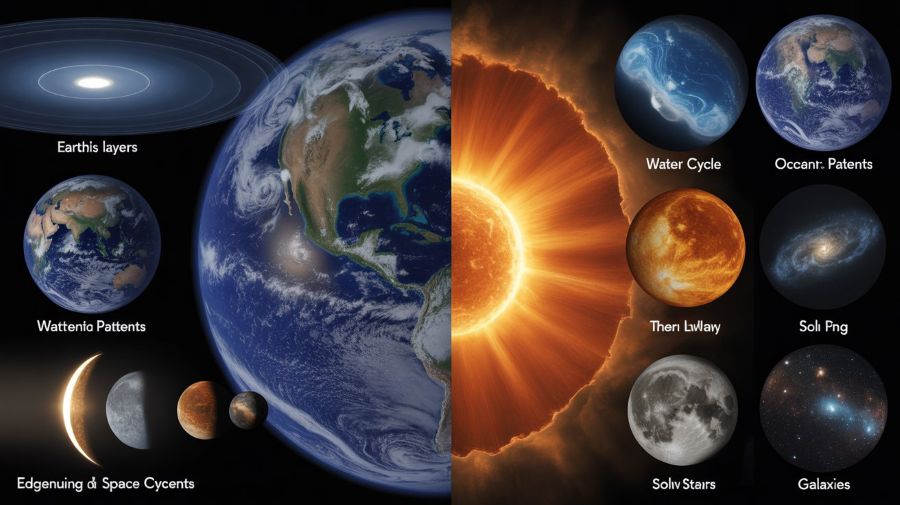
Layers of the Atmosphere:
- Troposphere
- Stratosphere
- Mesosphere
- Thermosphere
Weather occurs mainly in the troposphere.
Key topics include:
- Air pressure
- Wind systems
- Storm formation
- Ocean-atmosphere interactions
Many students struggle with interpreting weather maps, which drives searches for edgenuity earth and space science answers, but learning symbol meanings is more effective for exam performance.
In this unit, you’ll explore how the world’s oceans influence climate, weather, and life on Earth. Key topics include:
- Ocean Currents: Large-scale movements of water that distribute heat around the planet, regulating global climate.
- Salinity: The concentration of salt in seawater, which affects water density and circulation.
- Water Density: Differences in temperature and salinity drive the movement of ocean currents, including deep-water circulation.
- Global Water Movement: The combined effect of wind, Earth’s rotation, and density differences creates complex patterns like the thermohaline circulation, also known as the global conveyor belt.
Understanding oceans and currents is essential for many Edgenuity quizzes, and mastering these concepts reduces the need to search for Edgenuity Earth and Space Science answers.
Water is constantly moving through the environment in a continuous cycle called the hydrologic cycle. Understanding this cycle is essential for Earth science and many Edgenuity quizzes. The main stages include:
- Evaporation – Water from oceans, lakes, and rivers turns into water vapor due to heat from the sun.
- Condensation – Water vapor rises into the atmosphere, cools, and forms clouds.
- Precipitation – Water falls back to Earth as rain, snow, sleet, or hail.
- Runoff – Precipitation flows over land into rivers, lakes, and oceans.
- Collection – Water collects in bodies like lakes, oceans, or underground aquifers, ready to begin the cycle again.
This cycle ensures that water is continuously recycled and redistributed across the planet, supporting life, ecosystems, and weather patterns.
Human activities can disrupt the natural water cycle and reduce freshwater availability:
- Pollution: Chemicals, plastics, and waste contaminate rivers, lakes, and groundwater.
- Overuse: Excessive extraction for agriculture, industry, and cities depletes freshwater sources.
- Climate Change: Alters rainfall patterns, intensifies droughts, and increases floods.
- Deforestation: Reduces soil retention and affects runoff, leading to erosion and sedimentation in rivers.
By understanding both the water cycle and human impacts, students can better answer Edgenuity questions without solely relying on Edgenuity Earth and Space Science answers, while gaining real-world knowledge.
- Igneous
- Sedimentary
- Metamorphic
Earth’s 4.6-billion-year history is divided into eons, eras, periods, and epochs.
Fossils provide evidence of evolution, ancient climates, and geological changes. This unit is vocabulary-heavy, which is why searches for edgenuity earth and space science answers spike here. Use mnemonic devices for rock cycles and time scales.
Covers planets, moons, asteroids, comets, and formation theories.
Important phenomena:
- Eclipses
- Tides
- Moon phases
- Seasons
Earth’s axial tilt—not distance—causes seasonal changes, a common quiz question that leads many students to look up edgenuity earth and space science answers.
Learn about star life cycles, nuclear fusion, and HR diagrams.
Three main types: spiral, elliptical, irregular.
Topics include the Big Bang theory, dark matter, and cosmic background radiation. Because the concepts are abstract, many learners search online for edgenuity earth and space science answers, but understanding diagrams helps you avoid mistakes on tests.
While many students search for edgenuity earth and space science answers, it’s more beneficial to understand the material using these strategies:
Most Edgenuity lessons include downloadable guided notes—fill them in during the lesson.
Even if you miss questions, reviewing attempts helps you identify patterns.
Focus on:
- key vocabulary
- Earth layers
- rock cycle steps
- moon phases
- plate boundaries
Guessing leads to retakes and longer class times. Use logic and process of elimination. By adopting proper study strategies, you’ll spend less time searching for edgenuity earth and space science answers and more time mastering the content.
Using online test banks or copying edgenuity earth and space science answers might seem like a quick fix, but Edgenuity randomizes questions. Teachers also view progress, timestamps, and activity logs. To graduate confidently and understand real science, focus on learning—not shortcuts.
The Edgenuity Earth and Space Science course challenges students with detailed lessons on geology, weather, water cycles, and astronomy. Instead of relying on quick shortcuts like searching for edgenuity earth and space science answers, mastering the concepts will boost confidence, improve grades, and build real scientific understanding. Use this guide to study smarter and complete your coursework successfully.
You can use study guides, notes, and lesson summaries—mastering concepts works better than copying answers.
It covers multiple scientific fields. Breaking lessons into small segments helps.
No. Questions randomize, so memorizing answers is unreliable.
Review notes, watch all videos, and practice unit summaries.
Yes. Edgenuity tracks progress, time spent, and video interactions.
- The Ultimate Guide to ECMISS for Digital Businesses
- The History and Meaning Behind Denim Tears
- EO PIS: Modern Framework for Executive Performance
- Exploring the Future of Electricity and New Power Technologies